
Epiphany : Duane W.H. Arnold, PhD
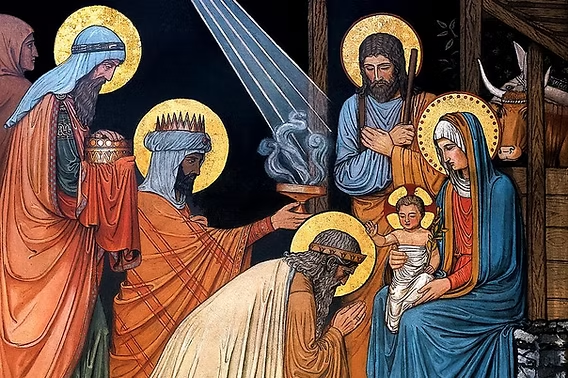 Epiphany
They arrive quietly, almost unnoticed at first. A small caravan of strangers from the East—learned men, foreign in dress and speech—entering Jerusalem not with proclamations but with a question. They have followed a light, a star whose meaning they have discerned through patient observation rather than inherited doctrine. They come expecting a king, because kings are where such signs ordinarily lead. What they do not know—what no one yet fully knows—is that the child they seek will not belong to any category available to them. The Magi come searching for power and find vulnerability; they come prepared for majesty and kneel before humility. That moment, recounted briefly and almost sparingly in Matthew’s Gospel, is what the Church has come to call Epiphany. It is not, however, a decorative flourish at the end of Christmas. It is the unsettling heart of the Incarnation itself.
Epiphany is not primarily about wise men, camels, or exotic gifts. It is about recognition—about who sees, who does not, and why. From the beginning, the story resists sentimentality. The Magi are not insiders. They do not belong to Israel. They are not trained in Torah or shaped by the promises of the prophets. They read the heavens, not the Scriptures. Yet it is they who see what others miss. They notice the star. They follow it. They are willing to leave home, cross borders, risk misunderstanding, and arrive asking questions that disturb both palace and temple alike: “Where is the child who has been born king?”
That question alone reveals the power of Epiphany. It exposes the fragility of those who assume that power is secure and the complacency of those who assume that knowledge is enough. Herod is frightened, because he understands exactly what is being asked. A new king, however small, is a threat to all kings. Jerusalem is troubled with him—not because it does not know the Scriptures, but because it knows them too well and has learned how to live safely alongside them. The religious scholars can quote the prophet Micah with ease. They know where the Messiah is to be born. Yet they do not go. Knowledge, in this story, is not the same as faith. Information does not become obedience. Scripture does not automatically become an encouragement to pilgrimage.
Epiphany matters now because we inhabit a similar landscape. Ours is an age saturated with information and yet remarkably poor in discernment. We know more than any generation before us, but we see less. We are endlessly connected, yet chronically inattentive. In such a world, Epiphany is not about God becoming obvious. It is about God becoming visible to those who have learned how to look.
The Magi do not stumble upon Christ accidentally. They are attentive people. They study patterns. They wait. They interpret signs. Their faith, such as it is, is not certainty but curiosity. They follow light without knowing where it will lead, trusting that meaning will reveal itself through movement. That posture stands in stark contrast to much modern religiosity, which, most often, prefers conclusions to journeys and answers to questions. We want clarity without cost, belief without risk, faith without commitment. Epiphany refuses all three.
Moreover, Epiphany disrupts our assumptions about where God may be found. The Magi expect to encounter a king in a palace. Instead, they are led to a child in a humble house, set in a village of no consequence. For, you see, God does not reveal himself at the center of power but at its margins. The star does not hover over the throne but over vulnerability. That reversal of expectations is not incidental. It is the pattern of the Gospel itself.
In the modern era, this should give the Church pause. We have become adept at managing God—at confining divine presence to our form of worship, our doctrines, our political alignments, and our cultural preferences. Epiphany insists that God is not managed. God is encountered. Often, that encounter occurs outside the boundaries that we have drawn so carefully.
The Magi are not corrected before they are welcomed. They are not interrogated about their theology. They are not required to renounce their methods. They arrive, they see, and they worship. Their gifts are not demanded by obligation; they are offered freely in response to recognition. Epiphany, then, is not a lesson in religious conformity but a revelation of divine hospitality.
That has implications for how the Church understands its vocation in a plural, fractured, and often suspicious world. If God chose to reveal Christ first to those outside the covenant, then the Church cannot afford to assume that it is the sole custodian of God’s activity. This does not diminish the Church’s calling; it deepens it. The Church is not the owner of revelation, but its servant and witness.
This is particularly pressing at a moment when Christianity in the West is anxious about its loss of cultural dominance. Too often, that anxiety has produced defensiveness rather than faithfulness. We react like Herod, protecting our influence, or like the scholars, retreating into texts while remaining unmoved. Epiphany calls us instead to the humility of the Magi—to curiosity, to listening, to movement toward light rather than away from uncertainty.
Epiphany also exposes a deeper modern problem: our resistance to being changed. The story ends with a quiet but decisive detail. Having encountered the child, the Magi return home by another way. Revelation alters geography. Encounter reshapes direction. One cannot meet God and simply resume the old route unchanged.
If Epiphany is to mean anything today, it must recover that disruptive edge. It must unsettle our certainties, challenge our allegiances, and re-train our vision. It must remind us that God’s self-disclosure is not obvious, not convenient, and not aligned with our expectations of success or control. God appears quietly, vulnerably, and often at the edges of our maps.
The question Epiphany ultimately asks is not whether God has revealed himself, but whether we are willing to follow the light we are given. Are we attentive enough to notice it? Humble enough to interpret it? Courageous enough to move toward it? And, finally, willing enough to abandon our plans and return by another way?
Those questions do not belong to the first century alone. Those questions belong to us as well.
Duane W.H. Arnold, PhD


This is excellent and personally timely for me.
I’ve run out of definitions, or find them all lacking in some way.
I’m trying to find those glimmers of light that lead…
Michael
The more I know of definitions, the more I know they don’t encompass the majesty of faith, much less the nature of God…
The more doctrines and dogmas we embrace in the service of certainty, the farther we get from what it means to walk in faith.
The more I let go of my need to know and know exactly, the more my faith grows…this is not comfortable , but is how find that our lives are hidden in Christ…
Because I teach Spanish, I get to share this story every year with my students under “cultural enrichment”, an opportunity I do not take for granted! We talk about the book the story comes from, what it means to some people, how many believe it is true (including their teacher) and why it is important to think of why God’s Son came to earth. My audience members are Hindus, Jews, Buddhists, “nones”, and a few actual Christians. I always need to rethink my own response to the story. It’s not just some guys bringing baubles to a baby; it’s some of the most important men of the time recognizing a Being greater than themselves who would change the world. And then there is Herod (my kids always want to know about Herod), a mean-spirited monarch who would stoop so low as to kill innocent babies because he could not stand to think of King other than himself.
All I can do is trust that God is good, and that God is merciful. I have debated with myself a thousand thousand times whether I believed the right doctrines, whether I had the right understanding, the right attitude, said the right words to God, whether my heart was right or pure enough. There’s no end to it– but to trust, trust that the same hand that created me, put me in this place and time, always had intended me to be the recipient of his unending love and will not abandon me, even though all others may. And the face that belongs to that hand will always for me be the face of Jesus Christ.
Linn
What strikes me most in what you describe is the seriousness with which you treat both the story and your students. You neither sentimentalize the narrative nor weaponize it. Instead, you allow it to stand as a claim—one that can be heard, questioned, resisted, or received, but not trivialized.
Your students are right to sense that this is not a tale about “baubles.” The Magi are not decorative figures; they represent power, learning, and status at the height of the ancient world. Their kneeling is the shock of the story. Something—or rather Someone—reorders their understanding of reality. Herod, by contrast, embodies what happens when power refuses to be decentered. His violence is not incidental; it is the predictable consequence of a world in which no rival to the self can be tolerated.
That you must rethink your own response each year is, I think, precisely the point. Epiphany is not a lesson one masters and then repeats. It is a story that keeps asking where we stand—among those who recognize a greater truth and are changed by it, or among those who, like Herod, cannot imagine a kingship that does not revolve around themselves. In a classroom as diverse as yours, that question is not only appropriate; it is unavoidable.
Robert F
In the end, trust in that hand that holds us is all that we have…
In Israel there is this tell called the “Herodium.”
It is just one of the Palaces which King Herod “the Great” (it is said he named himself “the Great” because of his admiration for Alexander the Great) built for himself and his legacy across the Land.
This palace had a tile lined reflection pool almost the size of a modern football field and was 10 feet deep. The whole palace was as grand as one could be, probably only eclipsed by what he built at Masada.
What no one ever talks about is where this palace, the “Herodium” was built. When one stands at the top and looks down across the reflection pool one can see Bethlehem off in the distance.
Eventually King Herod the Great’s body was found buried in his opulent palace not far from a simple cave used by shepherds to protect their sheep and where a young woman birthed her child.
Yes Herod knew the prophecy.
TH
I’ve been there, it’s truly remarkable…
Herod built more than just Masada and the Herodium:
https://drivethruhistoryadventures.com/king-herods-building-projects/
Given that the Jewish population never really accepted him and that the Roman Empire did, I think he went all out for his own ego, aggrandizement, his sense of safety (he was rather insecure and paranoid), and showing his Jewish subjects his importance regardless if they accepted him or not.
You are correct and one scholar I know told me he thought King Herod was one of if not the greatest builder of things in history.
One of the problems with know about Herod is most Christians only know about what is taught from the pulpit or Sunday School Class.
TH,
He certainly was, at least in that era. Due to the Roman Empire, its technology, infrastructure, political & economy stability, etc. it allowed Christianity to spread far from its roots in Judea.
In his self aggrandizement and cruelty, Herod reminds me of someone we know…
https://en.wikipedia.org/wiki/Herodian_architecture
Duane,
Herod died after an unidentified but excruciatingly painful, putrefying illness, known to posterity as “Herod’s Evil”. Of course if that happened to that someone else we know, I would break open the bottle of Bollinger. and read the obituary with great pleasure.