
Christmas Eve
 John Mason Neale: “Christmas Carols”
“The ground under part of the great city of Rome is tunnelled out into long dark passages called Catacombs. They had once served as quarries, but when no more stone could be got from them they were deserted; and being so very lonely, and so difficult to enter, they served for the poor Christians to meet in. And in the sides of these passages they used to bury their dead. You could see then–and those who have the great happiness to go there may see now–the epitaphs and figures they set up over those graves. A branch of palm, for example, signified a Martyr: a ship entering the harbour, set forth the departure of a common Christian. Here then creeping in stealthily, one by one, not knowing but that their persecutors might burst in on them, not knowing whether any moment might not see them dragged away to the wild beasts or to the rack, those first Christians spent their Christmas Eve. Their altar was generally the tomb of a Martyr; and there they set forth the death of Him Who is the Martyr of Martyrs. Christmas was no time of gladness then,–I mean of such gladness as we now make it. It was a time of fear and danger, and very often of separation; but a glorious time nevertheless. They knew something more of following CHRIST than we do in these days.
But, if we could, go now through Europe, in every great city, in every little village church, we should see multitudes preparing themselves to go up to the Midnight service which is everywhere said in remembrance of Him Who at midnight came into the world; for it is not as if we were alone, though we may seem cut off and separated from the rest of the world. We believe in the Communion of Saints: we believe that in all those prayers, which to-night shall be offered up by the Holy Church throughout all the world, we have a share. We believe that they and we are looking forward to that one long Feast, of which all these earthly feasts are poor and feeble types. We believe that they and we are looking back to that Birth, which was on this night as our only hope of escaping from that death which is eternal night.
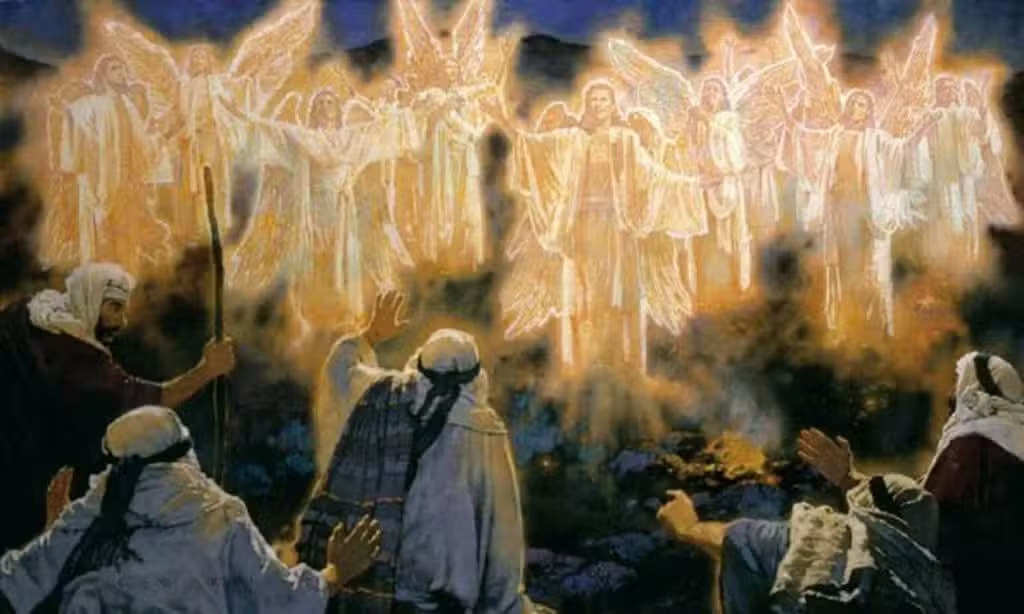
Truly this is the night wherein “a holy solemnity is kept;” and Isaiah tells us how to observe it. “There shall be a song,” says he. Now we are not to think that all these old customs are good only because they are old. We must not imagine that Christmas Carols are to be kept up only because they have been the fashion for so long. No; remember what was their first beginning. The first singers at Christmas time were the blessed Angels; and the first Christmas Carol they sang was, “Glory to GOD in the highest, and on earth peace, good will towards men.” And what was the effect of it? What did the shepherds say? Did they say, What lovely music! or What sweet voices! or, What a glorious sight? No; they said, “Let us now go even to Bethlehem.”
And so I say to you, “Let us go now even to Bethlehem.” Let us go to see Him Who, though He was King of kings, yet vouchsafed to become a Servant of servants. Let us go there to learn not to do our own will, but our FATHER’S: not to please ourselves, but Him Whose we are, and Whom we ought to serve. Let us go to Bethlehem. It is no such easy thing, in this sense; for if we have once learned this, and if we do it, we are not far from the Kingdom.
And so to go to Bethlehem is the only way by which we can hope hereafter to go up to the Heavenly Jerusalem: so to seek that Holy Infant now, is the only way in which we can expect to meet Him as a righteous Judge hereafter.
And so I end in the words of one of His saints:
“CHRIST, Who mad’st us out of dust,
Life and spirit giving;
CHRIST, from Whose dear steps we must
Pattern take of living:
CHRIST, Who earnest once to save
From the curse and from the grave,
Healing, lightening, cheering;
CHRIST, Who now wast made as we,
Grant that we may be like Thee
In Thy next appearing!”
Which He grant for His own Name’s sake: to Whom with the FATHER, and the HOLY GHOST, be all honour and glory for ever. Amen.”


Lovely! Thank you, Michael!
Michael,
Love it… Merry Christmas!
Thank you, Michael. I needed this reminder..
” Let us go there to learn not to do our own will, but our FATHER’S: not to please ourselves, but Him Whose we are, and Whom we ought to serve.”