
Is MAGA Apostate?
 I was reading this article by Roger Olson questioning whether German Christians that supported Hitler committed apostasy and it stirred some things in my soul.
I believe in some way at least, they did…which leads me to examine again what is happening today.
Throughout history, the illicit mating of faith and politics has often led to profound theological issues. The support of Germans for Adolf Hitler during the Nazi regime and the backing of Donald Trump by many evangelical Christians in contemporary America present striking, albeit troubling, similarities. Both phenomena reveal the complex dynamics at play when religious belief intertwines with political ideology, often resulting in significant moral compromises. I want to discuss those parallels, particularly through the lens of the Donatist conflict in the early church, which delved into the difficult question of apostasy and the conditions for reconciliation within a community of faith.
In the early 20th century, a fragmented Germany faced the tumultuous aftermath of World War I and the economic despair of the Weimar Republic. Hitler’s rise to power was characterized by a promise to restore Germany’s national pride and stability, appealing to a populace desperate for hope and direction. The Protestant churches, in particular, became arenas where nationalism and religion fused, often leading to compromises on ethical standards in favor of political expedience.
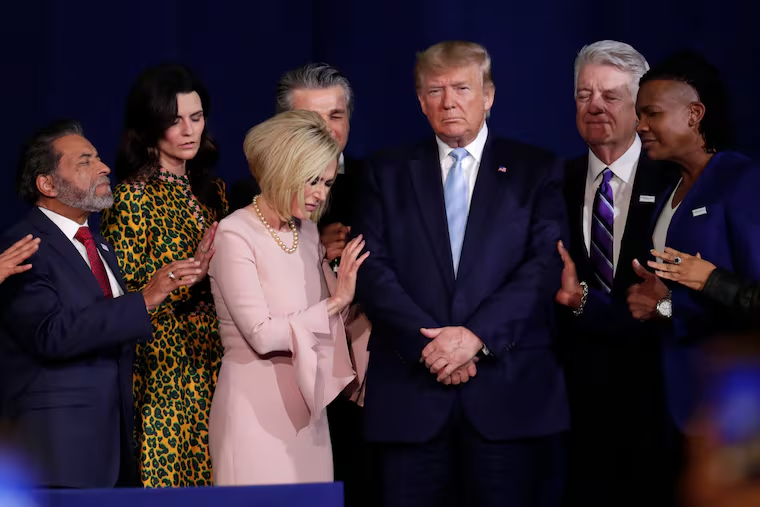
Similarly, the election of Donald Trump in 2016 galvanized a significant section of the evangelical community, a demographic that perceived him as a bulwark against what they viewed as encroaching secularism and a cultural left that threatened their values. Many evangelicals supported Trump not primarily out of alignment with his character or personal morals, but rather for political outcomes they believed would safeguard their beliefs and advocate for their interests, as well as take down their “enemies”.
In both cases, individuals aligned with these leaders often rationalized their support through a lens of theological justification. For German Christians, the “German Christians” movement sought to align Nazi ideologies with a version of Christianity that stripped Jewish influence from the faith, thereby creating a form of nationalism imbued with religious significance. This distortion allowed believers to overlook the fundamentally un-Christian nature of Hitler’s racial policies.
In a parallel fashion, many evangelicals have framed their support for Trump as a necessary evil, arguing that pragmatic choices must be made for the greater good. This rationale echoes with a theological justification rooted in a belief that political power can be harnessed to enact divine purpose, often sidelining the need for personal integrity or ethical consistency.
The Donatist conflict of the early church provides a poignant backdrop to understand these dynamics. The Donatists argued that those who had lapsed in faith—by renouncing their beliefs under persecution—should not be allowed to return to the church. This conflict revolved around purity, loyalty, and the integrity of the church community. The key question was whether those who had failed in their commitment could be granted forgiveness and restored to fellowship, despite their betrayal of the church and its members.
This analogous situation emerges in both the German Christian movement and evangelical support for Trump. In the former, the church became complicit in state-sponsored policies despite considerable theological and ethical compromises. Many Christians turned a blind eye to Hitler’s atrocities, prioritizing national loyalty over spiritual integrity, akin to the Donatist rejection of compromised believers. In the contemporary evangelical context, supporters often grapple with the moral implications of Trump’s behavior and rhetoric, trying to justify their support while wrestling with accusations of apostasy. The central question remains: when is it justifiable to overlook moral failings of political leaders for the sake of perceived larger causes?
The support of Germans for Hitler and the backing of Trump by many evangelicals reveal the complex ways in which faith can be instrumentalized for political allegiance. Both scenarios involve sacrificial compromises of religious integrity in favor of broader, often nationalistic goals. The Donatist conflict serves as a historical reminder of the dilemmas churches face regarding faithfulness, moral integrity, and the question of who truly belongs within the community of believers. As society examines the interplay of politics and faith, these historical parallels challenge believers to critically assess their allegiances, urging a thoughtful engagement with both the moral imperatives of their faith and the political realities of their context.
The questions before the house are profound. If MAGA is a form of apostasy, then those involved must repent…and if they repent, how does the church, especially those Trump and MAGA have harmed…respond?
I’ll try to answer that in my next article…


Michael,
Like you, I am thinking the answers are not as simple as “just forgive them!”
This is a watershed moment that is going to require repentance with a very high degree of rigor, something that is not popular in today’s churches, as much as it is said it is.
I watched Stephen Colbert’s interview with James Talarico and he got to the heart of why MAGA and it’s excesses have nothing to do with faith in Jesus and living out the life He has desired for us. As hard as it was to hear, it was also very healing for me as someone voiced my inner turmoil clearly and eloquently.
In my opinion, is MAGA apostate? Yes. A million times over, yes.
Laura,
I believe so as well.
The complexity comes from knowing the same people before they were “converted” to MAGA…back when they exhibited Christian character and virtues.
How can they not see that MAGA is incompatible with Christian virtue…or do they just not care?
Michael
The Donatist controversy remains instructive because it reminds us that the Church is perpetually navigating compromised saints and contested loyalties.
If MAGA—or any political movement—functions as an idol, repentance is required. If repentance occurs, forgiveness and restoration must follow, though not without truth-telling.
The Church’s credibility depends not on political triumph but on whether it can demonstrate that its ultimate allegiance truly belongs to Christ rather than to Caesar—whoever Caesar happens to be in a given generation.
Duane,
I worked on this one… 🙂
I agree with your conclusion…and I’ll write that up tomorrow.
Michael
” If repentance occurs, forgiveness and restoration must follow, though not without truth-telling.” The trouble is, what authority will determine repentance, forgiveness, restoration and truth telling? That is the tough one…
A big difference between the church of the first centuries and our time is the ancient church had strong institutional integrity, it could actually discipline adherents in a way that was felt and formed those who were deemed necessary of repentance; where is that church today? what leaders are recognized as authoritative enough to wield such power in a way that anyone feels compelled to repent? do American Christians care what the church as institution has to say? where is “the Church” and who are its leaders?
It took years to leave the thinking around Jim Crow, and some people never did leave it mentally or emotionally. Some folks still have fond memories of Nixon. I think it will take a long time to recover from MAGA as we have a group of people in America that believe that might makes right and that parts of the constitution aren’t true. Where MAGA is aligned with the Christian faith, we could see a great sorting out where many people leave those places of worship altogether, join a different church, or where the MAGA churches coalesce around something else. Since America is predicted to be majority minority between 2040-2045, it’s going to very difficult (in my opinion) to sustain MAGA.
MAGA / Christian Nationalism is much more than apostate. It is a CANCER and a BLIGHT on the political world and in the church. It cannot be reasoned with, played nice with, etc. Like cancer in a patient, it needs to be excised and eradicated with extreme prejudice. Period.
Let’s face what many do not want to acknowledge, the excessive ‘punishment’ of Germany by the treaty of Versailles, made Hitler possible.
At first, the thought of those in MAGA repenting sounds like a good problem to have. But I’m also faced with Trump-supporting friends who thought January 6th was awful and Trump guilty of insurrection, and then gradually went back all in for Trump again. They voted for him 3 times and would probably vote for a him a 4th. There “repentance” lasted a few months.
If this MAGA thing goes down in scandal, corruption and disaster, I can imagine believers involved saying they were never crazy about Trump, that the democrats were worse, and can we just move on? They will have learned nothing from the whole thing.
Terry and Michael
I was just talking to someone in person about these issues yesterday. It was interesting to read how other folks are thinking similarly to me. May all these things be to (1) bring “judgment to the house of God,” and (2) purify local churches. May God’s people become wiser for it.
I remember in 2016, 2020, and 2024 the whole rant about anti-maga Christians are ungodly and anti-maga pastors are cowards. That’s just the tip of the ice berg. May Christians learn from this…
Based on my own experience people who became MAGA are severely brainwashed by social media, talk radio and Fox News and other networks. Maybe they need to be treated with mercy?
Robin,
I agree with you. Of course MAGA people would say the same about their “enemies.” Except Fox would be CNN and all the other “fake news.”
I also agree with Robin. There’s a site called “Leaving Maga” with stories written by folks who left. What you find (I’ve read several) is that, well, it’s complicated. The stories aren’t always linear.
You realize getting out of maga can take a long time with lots of folks and situations involved in each one.
Muff,
I am well aware of the role the Treaty of Versailles played in causes of WWII. This is why at the end of WWII, the US opted to rebuild Germany and Japan and institute the Marshall Plan.